
Published · Reviewed · M&T Adjusters
This article provides general educational information. It does not interpret any policy, provide legal or safety advice, or guarantee coverage, payment, or results. The applicable policy, endorsements, facts of the loss, and insurer process control each claim. For health, fire, electrical, structural, or contamination hazards, follow public-authority and qualified-professional instructions.
Start with people and immediate hazards
A claim file is never more important than personal safety. Stay out of areas with standing water near electricity, active fire or smoke, unstable ceilings, downed lines, suspected gas leaks, or visible structural movement. Call emergency services when conditions require it, and wait for the appropriate authority or qualified professional before re-entering a dangerous area.
Once the property is safe enough to approach, make a short written timeline. Record when the damage was discovered, what you directly observed, any emergency calls made, and who entered the property. Use facts rather than theories about the cause. That first contemporaneous note can help keep later conversations accurate.
- Move occupants and pets away from unsafe areas.
- Photograph warning signs or restricted areas from a safe location.
- Keep emergency-service incident numbers and vendor contact information.
- Do not climb onto a wet, storm-damaged, or visibly unstable roof.
Document the scene before it changes
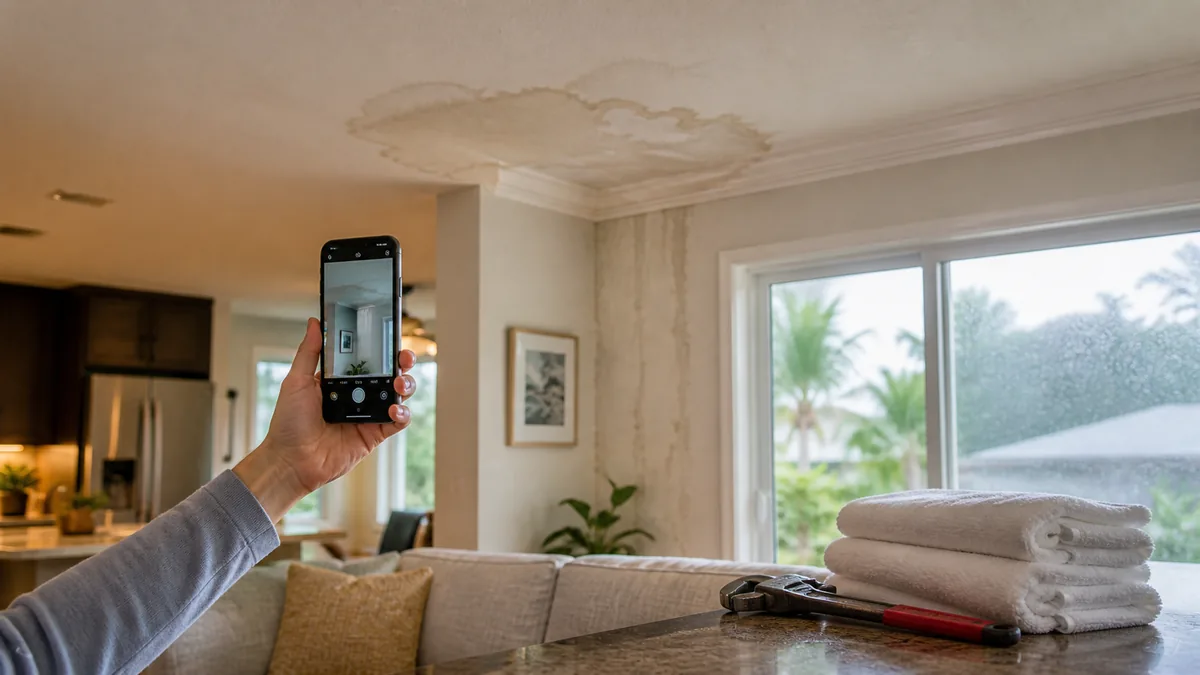
When it is safe, create a visual tour before cleanup or removal changes the scene. Begin outside with the building, roofline, openings, drainage, debris, and surrounding conditions. Inside, photograph each room from the doorway and then move closer to individual damaged materials and contents. A slow video with spoken room names can supplement still photographs but should not replace them.
Florida consumer guidance emphasizes keeping a home inventory and proof of ownership. For affected contents, record the item, room, brand or model when known, approximate age, condition, and the photo that shows it. Preserve receipts, card statements, manuals, or earlier family photographs that may establish ownership or pre-loss condition.
- Capture wide, medium, and close views of every affected area.
- Include a ruler or tape measure when scale matters and it is safe.
- Save original files with their dates and make a backup copy.
- Do not post policy numbers, claim numbers, checks, or private documents publicly.
Protect the property without erasing the record
Most property policies include duties after a loss, and Florida DFS tells consumers to review those conditions, take reasonable steps to protect the property, and keep accurate records and receipts. Examples may include covering an opening, shutting off a leaking supply line when safe, moving undamaged contents away from water, or arranging emergency board-up or extraction.
Photograph conditions before and after temporary work. Ask emergency vendors for an itemized scope, readings or measurements they took, photographs, invoices, and proof of payment. Distinguish emergency protection from permanent reconstruction. When health or safety requires disposal, photograph the item in place and retain a sample only if professionals say it is safe and appropriate.
- Use qualified, properly licensed vendors where a license is required.
- Keep tarping, board-up, drying, hotel, and supply receipts together.
- Avoid signing incomplete documents or contracts you do not understand.
- Ask the insurer before beginning non-emergency permanent repairs.
Give notice and build one organized claim file
Promptly contact the insurer or agent using the reporting method in the policy. Save the date, time, confirmation number, claim number, and the name or identifier of each representative. Ask what immediate documents are requested, where to upload them, and how future communications will be acknowledged. Do not rely only on a telephone conversation when a written confirmation is available.
Create one master folder with the policy and endorsements, photographs, inventory, estimates, invoices, receipts, correspondence, inspection notes, and payment explanations. Maintain a simple communication log. Florida deadlines can be event- and claim-specific, so review current policy language and official Florida DFS guidance rather than relying on an old checklist or a social-media deadline.
- Keep originals and send copies unless an original is specifically required.
- Write down every requested document and its submission date.
- Update the insurer if contact information or temporary lodging changes.
- Request clarification in writing when an instruction or decision is unclear.
Frequently asked questions
Clear answers, without promises.
Should I clean up before the insurance inspection?+
Address urgent safety and reasonable damage-prevention needs, but document the conditions first whenever it is safe. Preserve photographs, video, inventories, receipts, and appropriate samples before the scene changes.
What if I cannot safely enter the property?+
Do not enter. Follow emergency officials and qualified professionals, document from a safe location, and tell the insurer that access is restricted.
Does this checklist prove that my loss is covered?+
No. Good documentation helps explain the facts, but coverage and payment depend on the policy, endorsements, exclusions, conditions, and claim investigation.
Official sources
Sources used for this guide.
- Florida Department of Financial Services — Homeowners Insurance Overview
- Florida Office of the Insurance Consumer Advocate — Homeowners Insurance
- National Flood Insurance Program — How to Document Flood Damage
Last editorial review: . External pages may change.