
Published · Reviewed · M&T Adjusters
This article provides general educational information. It does not interpret any policy, provide legal or safety advice, or guarantee coverage, payment, or results. The applicable policy, endorsements, facts of the loss, and insurer process control each claim. For health, fire, electrical, structural, or contamination hazards, follow public-authority and qualified-professional instructions.
Use a comparison to explain a question
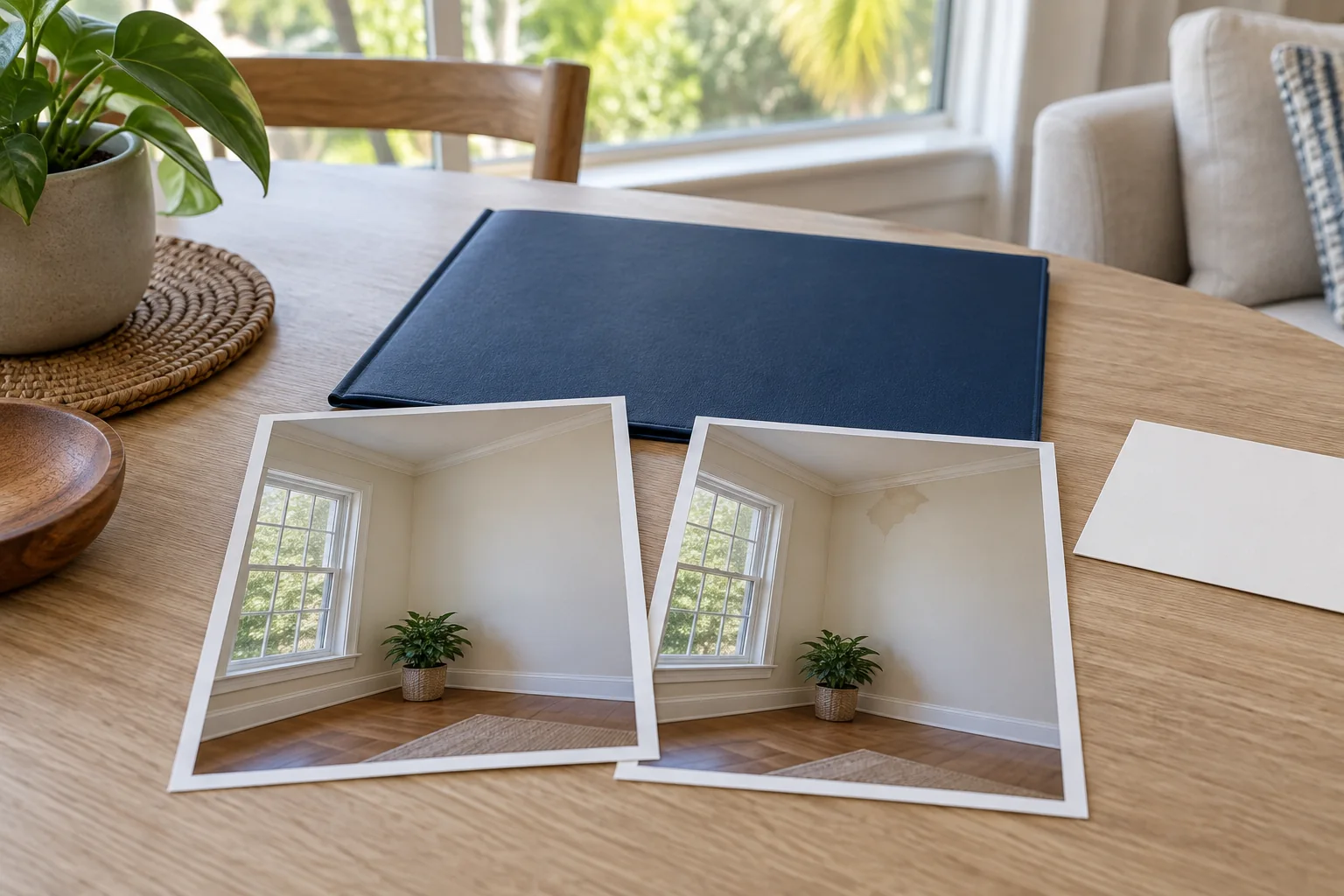
For a Florida property claim, pair an older photo with a newer one only after checking that they show the same location or component. Keep both originals and add a short note identifying the date, viewpoint, visible condition and limits of each image. A side-by-side comparison can help someone understand a change; it does not establish when damage began, what caused it or whether the policy covers it.
Florida’s Insurance Consumer Advocate recommends prompt reporting and photographs or video of damage in its Hurricane Recovery Resources, linked below. Do not delay reporting while searching for a perfect earlier photograph. The following comparison method is an optional way to organize records you already have, not a required claim form.
1. Find a relevant earlier view
Look through your own household photographs, prior inspection reports or repair records for the particular wall, ceiling, roof area or item in question. The NAIC’s homeowners-claim guide, linked below, suggests older household photos as a resource when rebuilding a belongings inventory. For a building-condition comparison, first ask whether the feature you want to discuss is actually visible.
Give each candidate an identifier such as OLD-01. Note who supplied it and keep the file as received. If it came from an inspection report, retain the report page and caption with it. A photograph showing most of a room may still leave the relevant corner out of frame. Mark that limitation instead of describing the entire room as undamaged.
2. Separate the photo date from the date you received it
Record the capture date when you can support it, along with the basis: original file information, an inspection report or the photographer’s recollection. Separately record when you received or downloaded the copy. If the original date is unknown, write “date unconfirmed.” Do not use a download date as though it were the date the scene was photographed.
An approximate date should remain approximate. If two records disagree, keep both and ask the source for clarification. Do not change an image’s date or rename it with an invented date to make the sequence look complete. Your index can explain an uncertainty without changing the original file.
3. Compare visible features, not just colors
Anchor the comparison to a fixed feature: the left edge of a window, a doorway or a ceiling junction. Describe which part appears in both images and which parts cannot be compared. Different lighting, distance, furniture placement and camera angle can limit what a reviewer can see. A darker patch in one image is an observation to investigate, not a diagnosis.
If a new matching view can be taken safely, include a wider location photo as well as the detail. Do not enter a damaged area or climb onto a roof to recreate an angle. Keep any annotated comparison as a separate copy with clear image identifiers; do not erase, enhance or generate missing detail in a photograph submitted as evidence.
- Location: room or exterior side, component and fixed reference point.
- Earlier image: identifier, supported date and what is visible.
- Later image: identifier, capture date and observed condition.
- Limits: blocked areas, different angles, uncertain dates or intervening work.
4. Include repairs and gaps between the pictures
A pair of photos may be separated by months of ordinary use, maintenance or other events. Add known repairs, painting, inspections and relevant observations to a short timeline, linking each entry to its record. Keep the date someone first noticed a condition distinct from a conclusion about when it started. If you do not know what happened between the images, say so.
Fictional example: an April living-room photo shows the upper wall, but a curtain hides the window corner. A September photo shows a stain beside that window. The accurate comparison is that the stain is visible in September and the April image does not show the same corner clearly. Calling it proof of a new storm leak would go beyond the photographs. A qualified inspection may help answer the remaining condition or cause questions.
5. Send a small, traceable comparison packet
Ask the insurer which file format and submission channel it accepts. Send the original files requested, a simple index and any clearly labeled comparison copy. The index should let the recipient locate every image without relying on a collage alone. Keep a copy of what you sent and the delivery confirmation in your communication log.
Share relevant claim records privately through verified channels. Keep unrelated household identities and account details out of a public post. If a new record changes your description, send a dated correction that identifies the earlier statement; preserve the original submission. M&T’s linked Florida photo guide covers taking a full room-by-room record, while its communication-log guide helps track questions and responses.
Frequently asked questions
Clear answers, without promises.
Does an older photo prove there was no prior damage?+
Only describe what is visible. A photograph may omit, obscure or lack enough detail to show a condition. State its limits and ask what additional inspection or records would help.
What if I cannot confirm the photo date?+
Label the date as unconfirmed and record where the file came from. Keep the received date separate. Do not invent a capture date or treat an approximate recollection as exact.
Should I send only a side-by-side collage?+
Ask the insurer what it needs. A labeled comparison can help explain your question, but keep and provide the requested originals and an index so each image can be reviewed separately.
Official sources
Sources used for this guide.
- Florida Insurance Consumer Advocate — Hurricane Recovery Resources
- NAIC — What You Need to Know When Filing a Homeowners Claim
- Related: Florida room-by-room photo documentation
- Related: Florida claim communication log
Last editorial review: . External pages may change.